

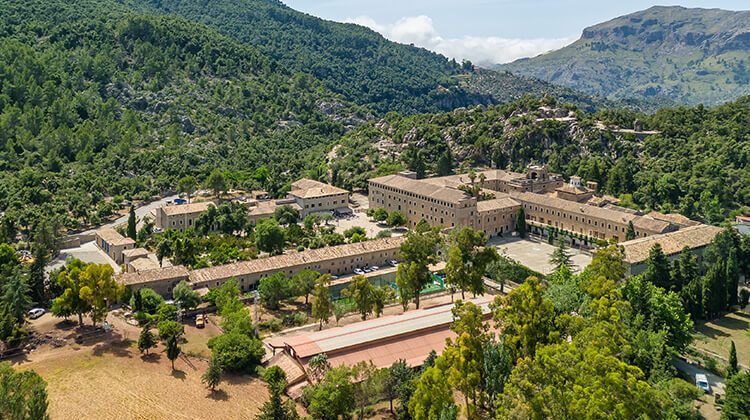
Most journeys to Mallorca begin by looking towards the sea. This one asks you to turn your back on it.
Follow the road into the Serra de Tramuntana and the island begins to change. Beaches disappear behind mountains. Stone terraces climb the hillsides. Pine and holm-oak forests replace the palms. The road twists higher into a landscape that appears increasingly removed from the Mallorca you thought you knew.
And then, deep in the mountains, you find Lluc.

For centuries, Mallorcans have come here on foot to pray, make promises, give thanks or simply carry on a journey their parents and grandparents made before them. Today, people arrive for many more reasons: history, architecture, hiking, nature, music or curiosity.
But the Santuari de Lluc is more than another stop on a Mallorca itinerary. To understand why this place matters, you have to begin with a shepherd boy, a monk and a small statue of the Virgin Mary that, according to legend, refused to stay where it was put.
Discover the spiritual heart of Mallorca
Set in the municipality of Escorca, surrounded by the Serra de Tramuntana, Santuari de Lluc is Mallorca’s most important pilgrimage site and one of the island’s great cultural and religious landmarks.
You will often see it called Lluc Monastery, although its full name is the Santuari de Santa Maria de Lluc. Its story reaches back to the 13th century, and what began as a small place of worship gradually developed into the sanctuary complex visitors see today.
At its centre is the Mare de Déu de Lluc, the Virgin of Lluc, patron saint of Mallorca.
For believers, Lluc is still a place of pilgrimage and devotion. But you don’t have to come here for religious reasons to appreciate its appeal.
There is the basilica. A botanical garden. A museum. Centuries of art and architecture. Mountain paths leading to stunning views. And beyond the walls, one of the most extraordinary landscapes in Mallorca.

Lluc sits within the Serra de Tramuntana cultural landscape, inscribed on UNESCO’s World Heritage List in 2011. It is difficult to think of a more appropriate setting for a sanctuary: a place shaped by both human hands and forces much older than us.
The legend of the Virgin who chose Lluc
Every old sanctuary deserves a story. Lluc has a particularly good one.
According to legend, not long after the Christian conquest of Mallorca in 1229, a shepherd boy and a monk discovered a stone image of the Virgin Mary in the landscape around Lluc. They carried the statue to the parish church of Escorca.
The following day, it was gone. The image had returned to the place where it had been found. So they carried it back to the church. Again, it disappeared. And again, it was found in the same place.

The story says this happened three times. Eventually, the message seemed difficult to misunderstand: if the Virgin would not remain in the church, a place of worship would have to be built where she had chosen to remain.
And so a small chapel was created.
Whether you take the story as a miracle, folklore or something somewhere between the two, its importance is difficult to overstate. For generations of Mallorcans, the legend has bound a particular landscape to a particular faith. And people kept coming.
From a 13th-century chapel to Mallorca’s great sanctuary
Behind the legend lies a documented history almost as fascinating.
Worship at Lluc was already established in the 13th century, and by the early 14th century provision was being made to shelter pilgrims travelling into the mountains. In 1317, permission was granted for a porch where they could take refuge from the difficult Tramuntana weather.
At the heart of that devotion is the image of the Virgin of Lluc that pilgrims still come to venerate today. The small, dark Gothic statue, affectionately known as La Moreneta, is made from polychrome sandstone and dates from between the 13th and 14th centuries. In 1884, it was solemnly crowned with the authorisation of Pope Leo XIII.
And around that devotion, Lluc grew.

In 1456, the Collegiate Church of Lluc was established. In 1622, the first stone of the present church was laid. The building was completed in 1691.
Centuries of additions, alterations and artistic interventions followed, leaving the sanctuary not as a monument frozen at one moment in history, but as something Mallorca repeatedly returned to, changed and cared for.
That may be the most interesting way to look at Lluc. Not simply as an old building, but as more than seven centuries of Mallorcan history gathered in one place.
Step inside the Basilica of Lluc
The exterior gives little warning of how richly decorated the church becomes once you cross its threshold.
The present building dates from the 17th century. Inside, its main altarpiece is the work of Mallorcan sculptor Jaume Blanquer, while the Camarín, a small chapel dedicated to the Virgin, forms the devotional heart of the sanctuary and is where La Moreneta can be venerated.

The building acquired further importance over the centuries. In 1962, Pope John XXIII elevated the church to the rank of minor basilica.
Look more carefully, and another famous name enters the story.
At the beginning of the 20th century, Bishop Pere Joan Campins promoted the restoration of the sanctuary and brought Antoni Gaudí into the project. Gaudí did not design Lluc, as is sometimes suggested, but he participated in plans for the reorganisation and decoration of the church.
It is one more layer in a building already full of them.
Then stop talking and listen: the Blauets de Lluc
There are places you remember for what you saw. Lluc may also stay with you because of what you heard.
Its choir school, the Escolania de Lluc, has roots reaching back centuries. Its singers are popularly known as the Blauets, a name derived from the blue robes traditionally worn by the choir.
The organised choir school dates to the 16th century, when six boys were entrusted with singing to the Virgin on behalf of Mallorca. Today the choir includes both boys and girls.

If your visit coincides with one of their performances in the basilica, pause. Don’t reach immediately for your phone. Just listen.
After the winding mountain road, the stone courtyards and the layers of history, hearing young voices filling the basilica may tell you more about why Lluc has survived as a living part of Mallorca than another plaque or date ever could.
Find another Mallorca in the Botanical Garden
A short distance from the main pilgrims’ square lies one of Lluc’s quieter surprises: its Botanical Garden.
Created in 1956 and later enlarged, the garden was designed to preserve and display the flora of Mallorca. Today it contains around 200 varieties of plants, including wild native species, aromatic and medicinal plants traditionally associated with the island and examples of old Mallorcan fruit trees.

This isn’t a polished ornamental garden designed for dramatic photographs. And that is precisely its charm. It feels intimately connected to the mountains surrounding it: a condensed lesson in the vegetation you may have been driving or walking past without knowing its name.
The garden is currently free to enter, with voluntary contributions welcomed. Opening times can change, so it is worth checking the sanctuary’s official website before visiting.
Walk up to the Mysteries of the Rosary
Before leaving, look for the cobbled path beginning at Plaza del Lledoner Centenario.
The route climbs towards the place where, according to tradition, the sacred image of the Virgin of Lluc was found. Along the way, you will pass five stone monuments decorated with bronze reliefs representing the mysteries of the Rosary.

The works were created by architects Joan Rubió and Guillem Reynés and sculptor Josep Llimona, with Antoni Gaudí acting as an adviser.
At the top, a large cross marks the spot traditionally associated with the discovery of the Virgin’s image. From here, the views open across the Lluc valley, the sanctuary rooftops and the surrounding Serra de Tramuntana.
The walk takes around 20 to 30 minutes.
It is one of those occasions when walking a little farther pays disproportionately well. Even visitors with no religious interest can appreciate the combination of sculpture, stone path, vegetation and mountain views.
The sanctuary makes more sense from up here.
It seems less like a building placed in the mountains and more like something that belongs to them.
Lluc is also a doorway into the Serra de Tramuntana
Don’t make the mistake of treating Lluc as an isolated attraction.
The landscape around it is part of the experience.
The Serra de Tramuntana runs for roughly 90 kilometres along Mallorca’s north-west and was recognised by UNESCO for the extraordinary cultural landscape created over centuries as people adapted steep, difficult terrain to agriculture and scarce water resources.

Dry-stone walls, terraces, paths, olive groves and water-management systems transformed the mountains without erasing them.
Lluc sits in the middle of this landscape and has long been connected to the rest of Mallorca by walking routes.
One historic approach climbs from Caimari towards the sanctuary along an old cobbled pilgrim path. Lluc is also connected with Mallorca’s network of long-distance walking routes, making it an excellent starting or finishing point for those who want to discover the Tramuntana on foot.
Even if hiking isn’t on your holiday agenda, leave enough time to wander beyond the main buildings.
Lluc rewards people who are not in a hurry.
How to get to Santuari de Lluc
Santuari de Lluc is located at Plaça dels Pelegrins in Escorca, in the central Serra de Tramuntana.
By car
For most visitors, driving is the simplest option and gives you the freedom to combine Lluc with other places in the Tramuntana.
The approach itself is part of the excursion, particularly as the roads begin to climb through the mountains. They are winding in places, so allow yourself time rather than treating the journey as something to get through as quickly as possible.
By bus
Mallorca’s TIB public transport network also serves Lluc. Routes and frequencies can vary according to timetable and season, so check the current TIB journey planner before travelling.
On foot
For walkers, arriving at Lluc under your own power is perhaps the most fitting approach of all. The historic route from Caimari follows in the footsteps of generations of pilgrims, while longer trails connect Lluc with the wider Serra de Tramuntana.
If you plan a substantial hike, always check the official route information and weather conditions before setting off.
Practical information for visiting Santuari de Lluc
Planning a visit to Santuari de Lluc? Here are the essentials to know before you go.
- Address: Plaça dels Pelegrins, 1, 07315 Escorca, Mallorca
- Opening hours and services: Opening hours for the basilica, museum, Ses Mides shop, Botanical Garden and Sa Fonda restaurant, as well as current Mass times, can be checked on the official Santuari de Lluc website.
- Parking: There is a car park next to the sanctuary, so visiting Lluc by car is straightforward. Parking charges may apply, so check the current rate on arrival.
- Food and drink: You don’t need to leave Lluc for lunch. The sanctuary has its own restaurant, Sa Fonda, serving traditional Mallorcan cuisine, as well as cafés and a bakery.
- Where to stay: Want to experience Lluc after the day visitors have left? The Hospedería del Santuari de Lluc offers rooms and self-catering apartments within the sanctuary complex, making it possible to spend the night in the heart of the Serra de Tramuntana.
- How long should you allow? For the basilica, Botanical Garden and walk to the Mysteries of the Rosary, allow roughly two hours at an unhurried pace. Give yourself longer if you want to visit the museum, have lunch or follow one of the surrounding walking trails.


Leave a Reply